
 English
 French
 Pubmed
 Google Scholar
 Cross Ref
 Visistor: 1968650
Insomnia in University and College Lecturers: Evidence Synthesis and Research Priorities for Vietnam
L'insomnie chez les enseignants du supérieur: synthèse des données probantes et priorités de recherche cho le Vietnam
Toi Nguyen-Van1, Sy Duong-Quy1,2,3,4, Giang Hoang Thi5
1Lam Dong Medical College. Lam Dong, Vietnam
2Vietnam Society of Sleep Medicine. Lam Dong, Vietnam
3Department of Sleep Medicine. University of Medicine and Pharmacy. Hanoi National University. Hanoi, Vietnam
4Penn State Medical College. PA, USA
5Department of Public Health, Hai Phong University of Medicine and Pharmacy, Hai Phong, Vietnam
Corresponding author: Toi Nguyen Van. Lam Dong Medical College. Lam Dong, Vietnam.
Mail: nguyentoi2808@gmail.com
ABSTRACT
Insomnia is a common sleep problem with important implications for mental health, daytime functioning, quality of life, and work performance. University and college lecturers may be especially vulnerable because their work combines teaching, research, student supervision, administrative duties, prolonged digital work, and recurring deadline pressure. This focused narrative review synthesizes clinically and conceptually relevant evidence on insomnia among lecturers, with emphasis on definitional and measurement issues, modifiable determinants, occupational consequences, and implications for Vietnam. A purposive search of PubMed/MEDLINE, Scopus, Web of Science, and Google Scholar was undertaken, with additional screening of key reviews, guidelines, and reference lists. Because lecturer-specific evidence was limited, conceptually relevant studies in teachers and other high-demand occupational groups were also considered. Available evidence suggests that sleep problems in academic staff are linked to occupational stress, long working hours, work-life imbalance, evening electronic-device use, and maladaptive sleep-related behaviors. These problems may adversely affect mood, concentration, productivity, and professional functioning. Although lecturer-specific intervention studies remain scarce, current guideline-based evidence supports multicomponent cognitive behavioral therapy for insomnia (CBT-I) as first-line treatment for chronic insomnia disorder in adults, and brief or digital formats may be especially relevant in time-constrained academic settings. In Vietnam, currently available evidence remains limited, mostly single-center, and insufficient to provide a robust multi-institutional picture. Stronger epidemiologic evidence, greater conceptual and measurement consistency, and evaluation of context-adapted behavioral interventions are needed.
KEYWORDS: Insomnia; Higher education faculty; Sleep disturbance; CBT-I; Vietnam.
RÉSUMÉ
L’insomnie est un trouble du sommeil fréquent ayant des répercussions importantes sur la santé mentale, le fonctionnement diurne, la qualité de vie et la performance au travail. Les enseignants du supérieur (universités et collèges) peuvent être particulièrement vulnérables car leur travail conjugue l'enseignement, la recherche, l'encadrement des étudiants, les tâches administratives, le travail numérique prolongé et la pression récurrente des délais. Cette revue narrative ciblée synthétise les données cliniquement et conceptuellement pertinentes sur l'insomnie chez les enseignants, en mettant l'accent sur les questions de définition et de mesure, les déterminants modifiables, les conséquences professionnelles et les implications pour le Vietnam. Une recherche intentionnelle sur PubMed/MEDLINE, Scopus, Web of Science et Google Scholar a été entreprise, complétée par un examen des principales revues, lignes directrices et listes de références. Les données spécifiques aux enseignants du supérieur étant limitées, des études conceptuellement pertinentes portant sur les enseignants du secondaire et d'autres groupes professionnels à forte exigence ont également été prises en compte. Les données disponibles suggèrent que les problèmes de sommeil chez le personnel académique sont liés au stress professionnel, aux longues heures de travail, au déséquilibre entre vie professionnelle et vie privée, à l'utilisation d'appareils électroniques le soir et à des comportements inadaptés liés au sommeil. Ces problèmes peuvent affecter négativement l'humeur, la concentration, la productivité et le fonctionnement professionnel. Bien que les études d'intervention spécifiques aux enseignants restent rares, les recommandations actuelles soutiennent la thérapie cognitivo-comportementale multicomposante de l'insomnie (TCC-I) comme traitement de première intention pour l'insomnie chronique chez l'adulte ; les formats brefs ou numériques pourraient être particulièrement pertinents dans les contextes académiques où le temps est limité. Au Vietnam, les données actuellement disponibles restent limitées, principalement monocentriques, et insuffisantes pour fournir un tableau multi-institutionnel robuste. Des preuves épidémiologiques plus solides, une plus grande cohérence conceptuelle et méthodologique, ainsi qu'une évaluation des interventions comportementales adaptées au contexte sont nécessaires.
MOTS CLÉS: Insomnie; Enseignants du supérieur; Troubles du sommeil; TCC-I; Vietnam.
INTRODUCTION
Insomnia is increasingly recognized as an important public-health and occupational-health concern because of its effects on mental health, daytime functioning, quality of life, and work performance [1,9,10]. Epidemiologic evidence suggests that approximately one in ten adults meets criteria for insomnia disorder, while a larger proportion reports clinically meaningful insomnia symptoms without meeting full diagnostic thresholds [1]. Insomnia is also associated with increased subsequent risk of depression, anxiety, and other adverse mental-health outcomes [10].
University and college lecturers may be particularly vulnerable to sleep problems because their work commonly combines teaching, research, student supervision, academic writing, institutional administration, and prolonged digital work. These overlapping demands may contribute to long working hours, irregular schedules, work-life boundary erosion, and persistent cognitive arousal, all of which are relevant to the development and maintenance of insomnia-related sleep problems [2-8]. However, lecturer-specific evidence remains limited and methodologically heterogeneous. Some studies assess insomnia symptoms, whereas others focus on poor sleep quality or broader sleep disturbance, making direct comparison difficult and increasing conceptual overlap between distinct sleep constructs.
In Vietnam, the evidence base is emerging but remains narrow. Recent single-center studies in university settings suggest a substantial burden of insomnia-related sleep problems among staff and lecturers, but these findings do not yet provide a robust multi-institutional picture [14,15]. At the same time, local work on sleep measurement, including studies of the Vietnamese version of the Pittsburgh Sleep Quality Index (PSQI), indicates growing national capacity for sleep-health research [16,17].
Against this background, this review synthesizes clinically and conceptually relevant evidence on insomnia among university and college lecturers, with emphasis on definitional and measurement issues, modifiable determinants, occupational consequences, and implications for research and behavioral intervention in Vietnam. Rather than attempting exhaustive retrieval, the review aims to provide a context-sensitive interpretation of the available literature and to identify a defensible agenda for future work in Vietnamese higher education.
METHODS OF THE NARRATIVE REVIEW
This article was conducted as a focused narrative review. A purposive search was undertaken in PubMed/MEDLINE, Scopus, Web of Science, and Google Scholar using combinations of terms related to insom nia, insomnia symptoms, sleep disturbance, sleep quality, university lecturer, college lecturer, faculty, academic staff, teacher, CBT-I, digital CBT-I, and behavioral sleep intervention. Vietnam-related and measurement terms, including Vietnam, Vietnamese, PSQI, and Insomnia Severity Index, were also used. Reference lists of key reviews, guidelines, and relevant primary studies were additionally screened.
Priority was given to English-language publications from approximately the past 10-15 years, while seminal earlier reviews and major clinical guidelines were retained where necessary. Eligible sources were selected for relevance to at least one of the following domains: conceptualization and assessment of insomnia-related outcomes, burden or prevalence, modifiable determinants, occupational consequences, behavioral intervention, and implications for Vietnam. Studies focusing primarily on unrelated sleep disorders, highly specific clinical populations with limited occupational relevance, or non-scholarly sources were not prioritized.
Because lecturer-specific evidence was limited, the review also considered conceptually relevant studies in teachers and other occupational groups with high cognitive or emotional demands. Owing to heterogeneity in populations, outcome definitions, and instruments, evidence was synthesized narratively rather than quantitatively. Particular attention was paid to distinguishing insomnia disorder, insomnia symptoms, sleep disturbance, and poor sleep quality, and stronger causal or intervention claims were avoided when evidence was indirect or methodologically limited.
DEFINING INSOMNIA AND ASSESSMENT ISSUES
Conceptual clarity is essential because insomnia, insomnia symptoms, sleep disturbance, and poor sleep quality are often used interchangeably in occupational research even though they do not represent the same construct [1,11,12]. At the clinical level, chronic insomnia disorder refers to persistent difficulty initiating sleep, maintaining sleep, or waking too early, accompanied by daytime impairment. By contrast, poor sleep quality is a broader subjective construct and may reflect short sleep duration, fragmented sleep, circadian misalignment, stress-related sleep disruption, or non-restorative sleep rather than insomnia disorder per se.
This distinction is especially important in lecturers. Academic staff may report poor sleep during peak workload periods without necessarily meeting criteria for chronic insomnia disorder. Studies using broad sleep-quality measures may therefore yield higher prevalence estimates than studies using stricter insomnia definitions. Lecturer-focused research should align the outcome measure with the study question and avoid treating all sleep complaints as clinically equivalent.
In practice, lecturer studies most commonly use the PSQI, the Insomnia Severity Index (ISI), and sleep diaries [2-6,8]. The PSQI is useful for profiling overall sleep quality, whereas the ISI is more suitable when the intent is to quantify insomnia-related severity. For Vietnamese research, this distinction is particularly important because the PSQI has undergone linguistic validation and psychometric assessment in Vietnamese samples, supporting its use in sleep-related research and community screening when the construct of interest is sleep quality rather than clinical insomnia severity [16,17].
INTERNATIONAL EVIDENCE IN LECTURERS AND RELATED OCCUPATIONAL GROUPS
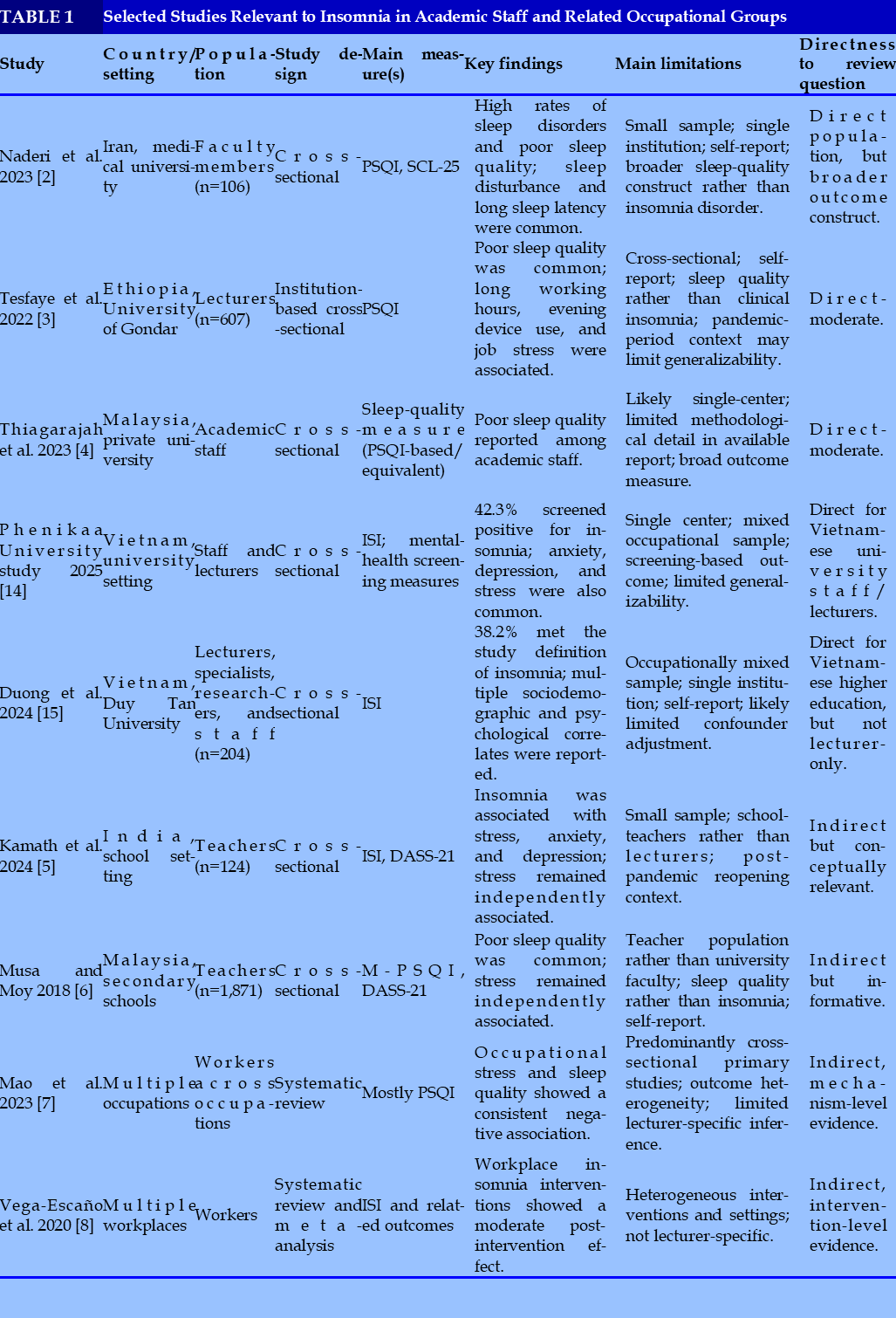
Direct evidence in university and college lecturers remains limited, but the available studies suggest that sleep problems in this population are clinically and occupationally relevant. A study of faculty members at Isfahan University of Medical Sciences reported high rates of sleep disorders and poor sleep quality [2], while Ethiopian data linked poor sleep quality with long working hours, electronic-device use before bedtime, and job stress [3]. In Southeast Asia, Malaysian academic staff also showed a notable burden of poor sleep quality [4]. Recent Vietnamese evidence points in the same direction: at Phenikaa University, 42.3% of staff and lecturers screened positive for insomnia using the ISI, and anxiety, depression, and stress were also frequently reported [14].
Although these studies differ in country, context, and measurement, they point toward a similar pattern: sleep problems among academic staff appear common enough to justify focused attention, yet the lecturer-specific evidence base remains too small and heterogeneous for strong prevalence claims. Another Vietnamese cross-sectional study at Duy Tan University found that 38.2% of surveyed lecturers, specialists, researchers, and staff met the study definition of insomnia, with significant associations reported for sex, education level, psychological status, occupation, and housing conditions [15]. These Vietnamese data are useful but still insufficient to support broad generalization across higher-education institutions.
Broader occupational evidence supports the same interpretation. A 2023 systematic review concluded that occupational stress and sleep quality show a consistent negative association across multiple professions, although most included studies were cross-sectional and based on subjective measures [7]. More broadly, Vietnamese sleep research in other university populations shows that poor sleep quality is not uncommon, which helps contextualize local measurement practice, but these findings should not be treated as direct lecturer evidence [18-21]. (Table 1)
CRITICAL APPRAISAL OF THE EVIDENCE BASE
The available evidence should be interpreted with caution. First, most lecturer-relevant studies identified in this review were cross-sectional, limiting causal inference and making temporal direction difficult to establish. Second, much of the literature relied on self-report instruments, which are vulnerable to recall bias, reporting bias, and construct overlap, especially when poor sleep quality is treated as equivalent to insomnia. Third, there was substantial heterogeneity in outcome definitions and measurement tools, particularly between studies using PSQI and those using ISI or broader sleep-disturbance measures, which limits direct comparability across studies. Fourth, several studies were single-center and based on convenience or institution-specific samples, reducing external validity. Finally, lecturer-specific evidence remains limited, so part of the interpretation necessarily depends on indirect evidence from teachers and other occupational groups with similar workload or stress profiles. Taken together, the current evidence is sufficient to justify concern and further research, but not strong enough to support precise prevalence estimates, causal claims, or context-independent intervention recommendations for Vietnamese lecturers.
MODIFIABLE DETERMINANTS AND OCCUPATIONAL CONSEQUENCES
The literature suggests four clusters of determinants that are especially relevant to lecturers. First, occupational demands such as long working hours, high teaching load, publication pressure, and administrative burden can reduce sleep opportunity and maintain cognitive arousal [2,3,6,7]. Second, behavioral factors such as evening electronic-device use, irregular sleep schedules, working late at night, and excessive reliance on caffeine may worsen both sleep quality and insomnia symptoms [3,8]. Third, psychological factors including perceived stress, anxiety, low mood, and difficulty detaching from work may intensify insomnia-related hyperarousal [5-7,10]. Fourth, organizational context matters: weak boundary control, a culture of after-hours responsiveness, and insufficient institutional support may reinforce maladaptive sleep behaviors.
These determinants are important because many are modifiable. For example, long working hours and late-evening device use were associated with poor sleep quality among Ethiopian lecturers [3]. In education-sector populations, stress remained independently associated with insomnia in Indian schoolteachers [5] and with poor sleep quality in Malaysian secondary-school teachers [6]. Although these studies were not all conducted in university settings, they illustrate mechanisms that are highly relevant to academic work and plausibly transferable to lecturers in Vietnam.
The occupational consequences are also likely to be meaningful. Insomnia is associated with fatigue, mood disturbance, impaired concentration, and reduced quality of life [1,9,10]. For higher-education faculty, these outcomes may translate into poorer teaching performance, reduced academic productivity, diminished professional engagement, and less effective interaction with students and colleagues. Direct studies on lecturer performance outcomes remain limited, but the broader insomnia literature supports the expectation that chronic sleep disruption can compromise functioning in cognitively demanding jobs [1,9,10].
IMPLICATIONS FOR INTERVENTION DEVELOPMENT
Current guideline-based evidence provides a clear direction for intervention development. The American Academy of Sleep Medicine strongly recommends multicomponent cognitive behavioral therapy for insomnia (CBT-I) for adults with chronic insomnia disorder, and the 2023 European Insomnia Guideline likewise places CBT-I as first-line treatment [11,12]. Brief multicomponent formats and selected single-component behavioral interventions may also be appropriate in some circumstances, but sleep hygiene alone is not considered an adequate stand-alone treatment for chronic insomnia disorder [11,12].
For lecturers, this has two practical implications. First, intervention discussions should move beyond generic sleep-hygiene advice. Because academic staff often experience persistent cognitive activation, irregular work schedules, and work-life boundary problems, multicomponent approaches that address stimulus control, sleep scheduling, dysfunctional sleep-related beliefs, and relaxation are more conceptually appropriate than simple advice to sleep earlier or avoid coffee. Second, delivery format matters. Digital CBT-I is of particular interest because face-to-face delivery is difficult to scale and digital tools can support self-monitoring, structured behavioral tasks, and flexible access.
A workplace-focused systematic review found that interventions targeting insomnia in workers can have a moderate positive effect, although study quality and intervention formats varied [8]. For higher-education faculty, this suggests that a staged program of intervention development may be more realistic than immediate large-scale implementation. Potentially feasible formats include brief CBT-I-informed programs, small-group delivery, digital or hybrid models, and interventions timed around teaching commitments. However, the present evidence does not justify claiming effectiveness specifically in Vietnamese lecturers. A more defensible conclusion is that CBT-I provides a well-supported framework that should be culturally and organizationally adapted, then tested for feasibility, acceptability, adherence, and preliminary effectiveness in this occupational group.
RESEARCH PRIORITIES FOR VIETNAM
Several priorities follow from the current evidence. First, Vietnam needs stronger epidemiologic data on insomnia and related sleep problems in higher-education faculty. Local evidence is no longer absent, but it remains limited and mostly single-center. Current studies provide useful initial estimates but do not yield a robust multi-center picture across universities, colleges, disciplines, or occupational subgroups within higher education [14,15].
Second, Vietnamese studies should explicitly distinguish insomnia symptoms, poor sleep quality, and probable insomnia disorder. Doing so would improve comparability across institutions and avoid inflating clinical conclusions from broad sleep-quality measures. This is especially important because the Vietnamese PSQI has published linguistic and psychometric work, making it a practical option for local research on sleep quality when used for the appropriate construct [16,17].
Third, future research should include determinants that are especially relevant to academic work, such as teaching load, administrative burden, publication pressure, evening device use, work-life boundary problems, and psychological distress. Student-based evidence in Vietnam suggests that phone use, sleep hygiene, noise, light, and academic pressure may matter, but these factors still require direct examination in lecturers and university employees [18-21].
Fourth, intervention research should proceed in stages. Early studies may focus on the feasibility and acceptability of brief or digitally supported CBT-I-informed approaches in lecturers, especially where specialist sleep services are limited. Later work may test preliminary effectiveness using insomnia severity, sleep quality, daytime functioning, and mental-health outcomes. A realistic Vietnamese research agenda should therefore link epidemiology, occupational determinants, and context-adapted intervention development rather than importing strong clinical claims from international literature without local testing.
LIMITATIONS
This article is a focused narrative review rather than a formal systematic review; accordingly, the search was purposive and interpretive rather than exhaustive. Although multiple databases were consulted, relevant studies may still have been missed, particularly gray literature, non-indexed local publications, or studies published in languages other than English or Vietnamese. The lecturer-specific evidence base was limited, and many of the included studies were cross-sectional and relied on self-report measures, which restricts causal inference and increase vulnerability to measurement bias. In addition, substantial heterogeneity in populations, outcome definitions, and instruments limited direct comparison across studies and precluded quantitative synthesis. Some inferences were necessarily drawn from teachers and other occupational groups with conceptually similar work demands; these findings should therefore be interpreted as indirect rather than lecturer-specific evidence. Finally, conclusions regarding evidence gaps in Vietnam should be read as cautious judgments based on accessible public-domain literature, not as proof that no additional local evidence exists.
CONCLUSION
Insomnia in university and college lecturers deserves greater attention as both a sleep-health and occupational-health issue. The available evidence indicates that academic staff are exposed to multiple potentially modifiable determinants of poor sleep, including long working hours, occupational stress, irregular sched ules, and technology-related disruption [2-8]. Emerging Vietnamese evidence is directionally consistent with this view but remains too limited for broad generalization [14,15]. For Vietnam, the most defensible next step is not to overstate the effectiveness of CBT-I in lecturers, but to use international evidence to guide a staged research agenda. That agenda should strengthen epidemiologic evidence, improve conceptual and measurement consistency, and test culturally and organizationally adapted behavioral sleep interventions in higher-education settings.
REFERENCES
| 1. Morin CM, Jarrin DC. Epidemiology of insomnia: prevalence, course, risk factors, and public health burden. Sleep Med Clin 2022;17:173-191. doi:10.1016/j.jsmc.2022.03.003. |
| 2. Naderi Z, Amra B, Ahmadi F, Emami Ardestani M. Evaluation of sleep quality in faculty members of Isfahan University of Medical Sciences. Int J Physiol Pathophysiol Pharmacol 2023;15:125-133. |
| 3. Tesfaye AH, et al. Risk factors for the prevalence of poor sleep quality in lecturers during COVID-19 pandemic in Ethiopia: an institution-based cross-sectional study. BMJ Open 2022;12:e066024. doi:10.1136/bmjopen-2022-066024. |
| 4. Thiagarajah K, Sit NW, Chee HP. Prevalence of sleep quality among academic staff of a private university in Malaysia. Malays J Med Health Sci 2023;19:28-34. doi:10.47836/mjmhs.19.6.5. |
| 5. Kamath SP, Mithra P, Kamath P, Unnikrishnan B. Insomnia in teachers at the time of resumption of in-person instruction at schools amidst the COVID-19 pandemic: a cross-sectional study. F1000Research 2024;12:1217. doi:10.12688/f1000research.141274.2. |
| 6. Musa NA, Moy FM. Prevalence and factors associated with poor sleep quality among secondary school teachers in a developing country. Ind Health 2018;56:407-418. doi:10.2486/indhealth.2018-0052. |
| 7. Mao Y, Raju G, Zabidi MA. Association between occupational stress and sleep quality: a systematic review. Nat Sci Sleep 2023;15:931-947. doi:10.2147/NSS.S431442. |
| 8. Vega-Escaño J, et al. Insomnia interventions in the workplace: a systematic review and meta-analysis. Int J Environ Res Public Health 2020;17:6717. doi:10.3390/ijerph17186717. |
| 9. Lim DC, et al. The need to promote sleep health in public health agendas across the life course. Lancet Public Health 2023;8:e820-e826. |
| 10. Hertenstein E, Feige B, Gmeiner T, et al. Insomnia as a predictor of mental disorders: a systematic review and meta-analysis. Sleep Med Rev 2019;43:96-105. doi:10.1016/j.smrv.2018.10.006. |
| 11. Edinger JD, Arnedt JT, Bertisch SM, et al. Behavioral and psychological treatments for chronic insomnia disorder in adults: an American Academy of Sleep Medicine clinical practice guideline. J Clin Sleep Med 2021;17:255-262. doi:10.5664/jcsm.8986. |
| 12. Riemann D, Espie CA, Altena E, et al. The European Insomnia Guideline: an update on the diagnosis and treatment of insomnia 2023. J Sleep Res 2023;32:e14035. doi:10.1111/jsr.14035. |
| 13. Uyumaz BE, Feijs L, Hu J. A review of digital cognitive behavioral therapy for insomnia (CBT-I apps): are they designed for engagement? Int J Environ Res Public Health 2021;18:2929. doi:10.3390/ijerph18062929. |
| 14. Bui Thi Huyen Trang, Le Quynh Trang, Le Thanh Thao, Nguyen Ngoc Anh, Hoang Thi Xuan Huong. Insomnia and mental health status among staff and lecturers at Phenikaa University. Vietnam Journal of Community Medicine 2025;66(Special Issue 10):1-6. doi:10.52163/yhc.v66iCD10.2604. |
| 15. Tran Thi Thuan, Pham Thi Yen Nhi, Ta Thi Thanh, Thieu Anh Tai, Phan Thi Thao Trang, Tran Minh Duc, Duong Thi Thuan. Survey on the sleep quality of staff and lecturers at Duy Tan University in 2023-2024. DTU Journal of Science and Technology 2024;6(67):115-124. |
| 16. To Minh Ngoc, Nguyen Do Nguyen, Phung Khanh Lam, Nguyen Xuan Bich Huyen, Tran Thi Xuan Lan. Vietnamese version of the Pittsburgh Sleep Quality Index. Y Hoc TP Ho Chi Minh 2014;18(Suppl 6):664-668. |
| 17. Ngoc TM, Nguyen ND, Lam PK, Tran TXL, Huyen NXB. Validity of the Vietnamese version of the Pittsburgh Sleep Quality Index. Vietnam Journal of Preventive Medicine 2017;27:50-56. |
| 18. Nguyen Thi Thu Huong, Le Dinh Luyen, Doan Ngoc Thuy Tien, Dam Thi Ngoc Anh, Vo Thi Thuy Ha, Tran Kim Thanh, et al. Sleep quality and related factors among students at Hanoi Medical University. Journal of Health Research and Development Studies. 2022;6(6):27-34. doi:10.38148/JHDS.0606SKPT22-096. |
| 19. To Thi Bich Thuy. Assessment of sleep quality among students majoring in physical education at Ho Chi Minh City University of Physical Education and Sport. Dong A University Journal of Science. 2024;3(3):26-37. doi:10.59907/daujs.3.3.2024.327. |
| 20. Vo Le Quang Tri, Tran Van Phuc, Nguyen Thi Minh Ngoc, Nguyen Huynh Kieu My, Tran Van De, Pham Kieu Anh Tho. Sleep quality and related factors among third-year medical students at Can Tho University of Medicine and Pharmacy. Can Tho Journal of Medicine and Pharmacy. 2023;9(5):29-35. |
| 21. Nguyen Thi Hong Hanh, Vo Trang Hien Muoi, Tran Kha Vi, Nguyen Thi Hanh Vy, Nguyen Thuy Vy, Le Trung Hieu, et al. Sleep quality and related factors among students at Can Tho University of Medicine and Pharmacy in 2022. Can Tho Journal of Medicine and Pharmacy. 2024;(70):120-127. |

FIGURES - TABLES
REFERENCES
| 1. Morin CM, Jarrin DC. Epidemiology of insomnia: prevalence, course, risk factors, and public health burden. Sleep Med Clin 2022;17:173-191. doi:10.1016/j.jsmc.2022.03.003. |
| 2. Naderi Z, Amra B, Ahmadi F, Emami Ardestani M. Evaluation of sleep quality in faculty members of Isfahan University of Medical Sciences. Int J Physiol Pathophysiol Pharmacol 2023;15:125-133. |
| 3. Tesfaye AH, et al. Risk factors for the prevalence of poor sleep quality in lecturers during COVID-19 pandemic in Ethiopia: an institution-based cross-sectional study. BMJ Open 2022;12:e066024. doi:10.1136/bmjopen-2022-066024. |
| 4. Thiagarajah K, Sit NW, Chee HP. Prevalence of sleep quality among academic staff of a private university in Malaysia. Malays J Med Health Sci 2023;19:28-34. doi:10.47836/mjmhs.19.6.5. |
| 5. Kamath SP, Mithra P, Kamath P, Unnikrishnan B. Insomnia in teachers at the time of resumption of in-person instruction at schools amidst the COVID-19 pandemic: a cross-sectional study. F1000Research 2024;12:1217. doi:10.12688/f1000research.141274.2. |
| 6. Musa NA, Moy FM. Prevalence and factors associated with poor sleep quality among secondary school teachers in a developing country. Ind Health 2018;56:407-418. doi:10.2486/indhealth.2018-0052. |
| 7. Mao Y, Raju G, Zabidi MA. Association between occupational stress and sleep quality: a systematic review. Nat Sci Sleep 2023;15:931-947. doi:10.2147/NSS.S431442. |
| 8. Vega-Escaño J, et al. Insomnia interventions in the workplace: a systematic review and meta-analysis. Int J Environ Res Public Health 2020;17:6717. doi:10.3390/ijerph17186717. |
| 9. Lim DC, et al. The need to promote sleep health in public health agendas across the life course. Lancet Public Health 2023;8:e820-e826. |
| 10. Hertenstein E, Feige B, Gmeiner T, et al. Insomnia as a predictor of mental disorders: a systematic review and meta-analysis. Sleep Med Rev 2019;43:96-105. doi:10.1016/j.smrv.2018.10.006. |
| 11. Edinger JD, Arnedt JT, Bertisch SM, et al. Behavioral and psychological treatments for chronic insomnia disorder in adults: an American Academy of Sleep Medicine clinical practice guideline. J Clin Sleep Med 2021;17:255-262. doi:10.5664/jcsm.8986. |
| 12. Riemann D, Espie CA, Altena E, et al. The European Insomnia Guideline: an update on the diagnosis and treatment of insomnia 2023. J Sleep Res 2023;32:e14035. doi:10.1111/jsr.14035. |
| 13. Uyumaz BE, Feijs L, Hu J. A review of digital cognitive behavioral therapy for insomnia (CBT-I apps): are they designed for engagement? Int J Environ Res Public Health 2021;18:2929. doi:10.3390/ijerph18062929. |
| 14. Bui Thi Huyen Trang, Le Quynh Trang, Le Thanh Thao, Nguyen Ngoc Anh, Hoang Thi Xuan Huong. Insomnia and mental health status among staff and lecturers at Phenikaa University. Vietnam Journal of Community Medicine 2025;66(Special Issue 10):1-6. doi:10.52163/yhc.v66iCD10.2604. |
| 15. Tran Thi Thuan, Pham Thi Yen Nhi, Ta Thi Thanh, Thieu Anh Tai, Phan Thi Thao Trang, Tran Minh Duc, Duong Thi Thuan. Survey on the sleep quality of staff and lecturers at Duy Tan University in 2023-2024. DTU Journal of Science and Technology 2024;6(67):115-124. |
| 16. To Minh Ngoc, Nguyen Do Nguyen, Phung Khanh Lam, Nguyen Xuan Bich Huyen, Tran Thi Xuan Lan. Vietnamese version of the Pittsburgh Sleep Quality Index. Y Hoc TP Ho Chi Minh 2014;18(Suppl 6):664-668. |
| 17. Ngoc TM, Nguyen ND, Lam PK, Tran TXL, Huyen NXB. Validity of the Vietnamese version of the Pittsburgh Sleep Quality Index. Vietnam Journal of Preventive Medicine 2017;27:50-56. |
| 18. Nguyen Thi Thu Huong, Le Dinh Luyen, Doan Ngoc Thuy Tien, Dam Thi Ngoc Anh, Vo Thi Thuy Ha, Tran Kim Thanh, et al. Sleep quality and related factors among students at Hanoi Medical University. Journal of Health Research and Development Studies. 2022;6(6):27-34. doi:10.38148/JHDS.0606SKPT22-096. |
| 19. To Thi Bich Thuy. Assessment of sleep quality among students majoring in physical education at Ho Chi Minh City University of Physical Education and Sport. Dong A University Journal of Science. 2024;3(3):26-37. doi:10.59907/daujs.3.3.2024.327. |
| 20. Vo Le Quang Tri, Tran Van Phuc, Nguyen Thi Minh Ngoc, Nguyen Huynh Kieu My, Tran Van De, Pham Kieu Anh Tho. Sleep quality and related factors among third-year medical students at Can Tho University of Medicine and Pharmacy. Can Tho Journal of Medicine and Pharmacy. 2023;9(5):29-35. |
| 21. Nguyen Thi Hong Hanh, Vo Trang Hien Muoi, Tran Kha Vi, Nguyen Thi Hanh Vy, Nguyen Thuy Vy, Le Trung Hieu, et al. Sleep quality and related factors among students at Can Tho University of Medicine and Pharmacy in 2022. Can Tho Journal of Medicine and Pharmacy. 2024;(70):120-127. |
ARTICLE INFO DOI:10.12699/jfvpulm.17.53.2026.01
Conflict of Interest
Non
Date of manuscript receiving
10/01/2025
Date of publication after correction
06/05/2026
Article citation
Toi Nguyen-Van, Sy Duong-Quy, Giang Hoang Thi. Insomnia in University and College Lecturers: Evidence Synthesis and Research Priorities for Vietnam. J Fran Vent PulmS 2026;53(17):1-7